
Bagamoyo Tanzania is one of the east African country’s most historically fascinating coastal towns. Despite this, it receives little interest from international visitors focused on Zanzibar or Dar es Salaam. Its location on the Indian Ocean coast, about 75km north of Dar es Salaam, made it an ideal trading post and shaped its destiny. Bagamoyo’s story is a complex tale of Swahili traders, Arab merchants, European explorers, missionaries and the East African slave trade.
Bagamoyo, Tanzania: Things to Do in This Historic Coastal Town
I spent several days exploring Bagamoyo, walking its historic centre, both solo and with a local guide. I also visited the nearby Kaole Ruins. What I discovered was a town with an extraordinary history, atmospheric streets and a distinctly different character from Tanzania’s better-known tourist destinations.
Whether you are considering a day trip from Dar es Salaam, looking for somewhere to explore for a few days, or breaking your journey to Saadani National Park, Bagamoyo deserves consideration.
Here is my guide to the best things to do in Bagamoyo and why I think it is worth visiting.
The Do Not Go Gently Travel Blog uses affiliate links. If you make a purchase after clicking on one of these links, I may receive a small commission payment at no extra cost to you.
A brief history of Bagamoyo
Bagamoyo’s history is intertwined with the development of trade along the East African coast. For centuries, it was an important settlement within the Swahili trading network, with connections extending across the Indian Ocean.
The town’s heyday was the nineteenth century when it became a major trading centre for ivory and slaves. Caravans travelled inland from the African interior, bringing goods to the coast, where they were traded and transported overseas.
The town subsequently became an important centre for European exploration and missionary activity. It was also the first capital of German East Africa before the colonial administration moved to Dar es Salaam.
The name Bagamoyo is commonly translated as ‘Lay down your heart’, although its precise origins are debated. It is often associated with the suffering of enslaved people who passed through the town.
“Doctor Livingstone, I Presume?” – Stanley and Livingstone in Bagamoyo
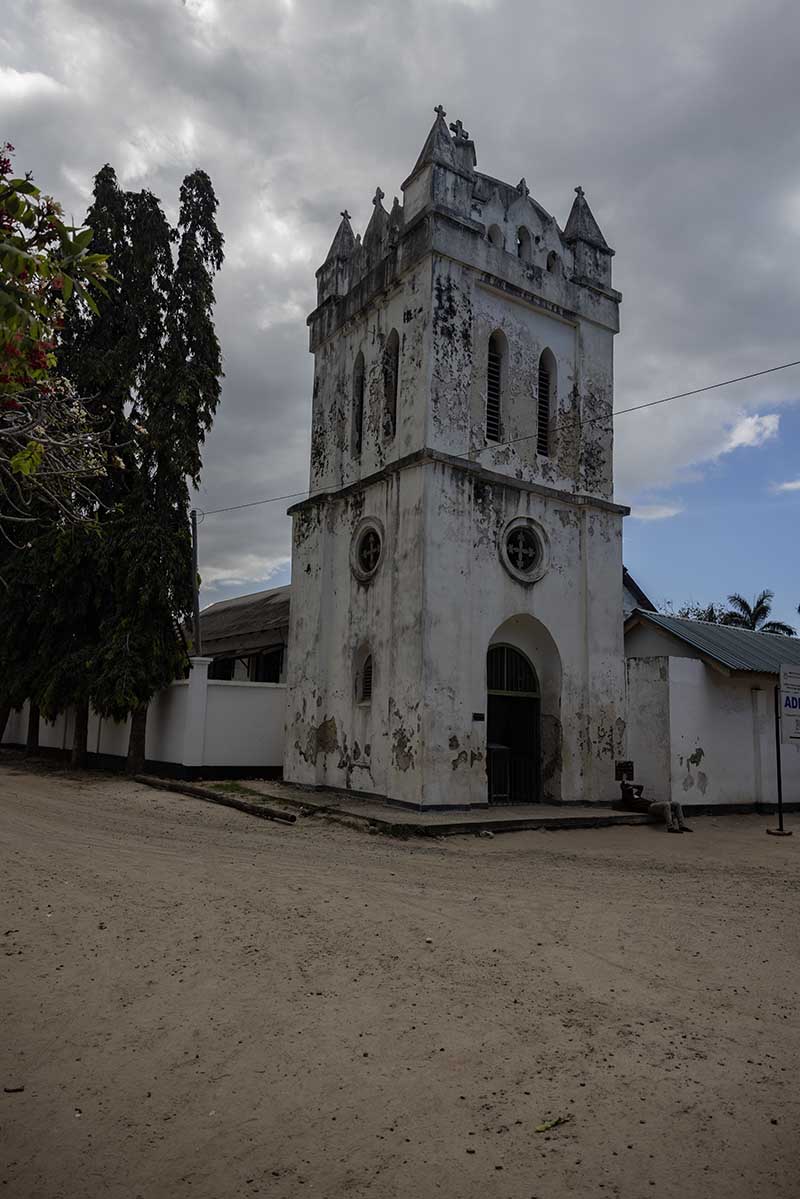
Bagamoyo was also the starting point for Henry Morton Stanley’s famous 1871 expedition to find David Livingstone. In his book, “How I Found Livingstone”, Stanley describes establishing his camp in a house on the western outskirts of the town before setting off into the African interior. Whereas there isn’t a monument to Stanley in Bagamoyo today, the town has a much more tangible connection to Livingstone.
He never visited Bagamoyo during his lifetime, but after his death in present-day Zambia in 1873, his body was carried to the coast by his African companions. It rested overnight in Livingstone Tower, part of the original Holy Ghost Mission church, in February 1874 before being taken to Zanzibar and eventually England for burial in Westminster Abbey.
The two explorers are therefore linked to Bagamoyo in very different ways: Stanley departed from here on his search for Livingstone, while Livingstone’s final journey brought his remains to the town.
Today, Bagamoyo is a very different place, but its historic buildings, religious sites and archaeological remains tell its story. Exploring them offers a fascinating insight into Tanzania’s coastal history.
Best things to do in Bagamoyo
Explore Bagamoyo’s historic old town
The best way to understand Bagamoyo is to explore its compact historic centre on foot.
My go-to when visiting a new place is a walking tour. I find that they not only give me a good feel for the place, but they orient me for the rest of my stay. In Bagamoyo, I took this one, which I would strongly recommend. Many of the buildings are interesting in their own right, but having someone explain their history and significance makes the experience considerably more rewarding.
One word of warning, the guide arranged transport from the historic centre to the ruins. It turned out to be a motorbike. Apparently, we were both expected to get on (plus the driver). I held out for a tuktuk!
The old town contains a mixture of Swahili, Arab, Indian and European architectural influences. Look out for traditional carved wooden doors, old merchant houses, narrow streets and buildings that have survived from the town’s trading heyday.
Some buildings are in better condition than others, and the area is not a polished historical attraction. That is part of its appeal. Bagamoyo remains a living town rather than a museum constructed for tourists.
Allow several hours for a walking tour, particularly if you are interested in the history of the slave trade and the German colonial period.
Visit the Old Boma

One of Bagamoyo’s most recognisable historic buildings is the Old Boma, associated with the German colonial administration. Built during the late nineteenth century, it reflects the period when Bagamoyo was an important administrative centre in German East Africa.
The building is an important part of the town’s architectural heritage and provides a useful starting point for understanding the German colonial period.
Its location within the historic centre makes it easy to incorporate into a walking tour, or simply while on a stroll from your hotel.
Discover Bagamoyo’s Old Fort
The Old Fort, also known as the Arab Fort, is another important historical building.
Also built during the height of Bagamoyo’s importance in the nineteenth century, the fort is associated with the coastal trading networks. It’s also central to the history of the slave trade.
As with many of Bagamoyo’s historic buildings, its significance becomes much clearer when you understand the wider history of the town.
Visit the Catholic Mission Museum
Bagamoyo has an important place in the history of Christianity in East Africa.
The Catholic mission was established in the nineteenth century, and the museum provides an insight into the work of missionaries and the history of the early Christian community. The mission is also associated with the abolitionist movement and efforts to assist people escaping slavery.
The museum is a worthwhile addition to a historical tour, particularly if you want to understand how European missionaries influenced the development of the town.
Explore the Kaole Ruins

Kaole Ruins should be high on your list of things to do in Bagamoyo.
Situated a short distance south of the town, this archaeological site contains the remains of a thirteenth-century settlement.
The ruins include the remains of mosques, tombs and other structures dating back several centuries. They provide evidence of important coastal trading communities long before the arrival of European colonial powers.
The site is particularly interesting because it demonstrates the extent of the Swahili civilisation and its connections with the wider Indian Ocean trading world.
I visited Kaole as part of my exploration of Bagamoyo and recommend allowing time to see it rather than concentrating exclusively on the historic centre. My first visit was part of a wider walking tour, and it coincided with several school visits. I went back early (they open at 9am) for a quieter experience.
Visit Bagamoyo’s Fish Market and Dhow Harbour
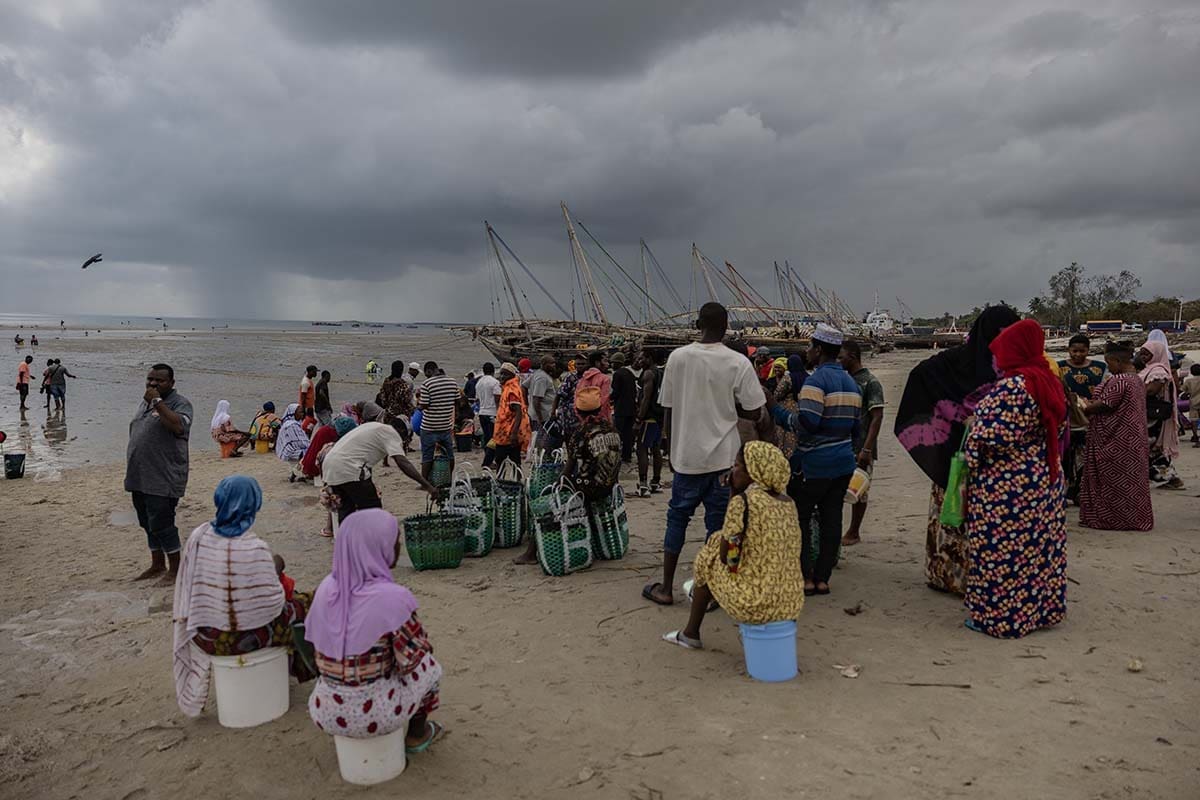
Bagamoyo is still very much a working coastal town, and its fishing industry is an important part of everyday life. The fish market and harbour provide an opportunity to see a different side of the town, away from its historic attractions.
Traditional wooden dhows remain part of the coastal landscape, reflecting the maritime heritage of the Swahili coast. Early morning is the best time to experience fishing activities. Local people sit on the beach, waiting for the boats to return with the day’s catch.
It is also an interesting opportunity for photography, particularly if you enjoy documenting everyday life rather than concentrating exclusively on traditional tourist attractions. However, be respectful when taking photos. Many locals culturally dislike being photographed. I always ask beforehand, but one elderly man still got angry with me.
Explore Bagamoyo’s beaches and mangroves

Bagamoyo’s coastline offers a quieter alternative to some of Tanzania’s more developed beach destinations.
You won’t find the same concentration of beach resorts and tourist facilities as on Zanzibar, but there are stretches of coastline where you can enjoy the Indian Ocean and escape the busier parts of town.
The surrounding mangroves are also worth exploring. These coastal habitats support a variety of wildlife and bird life, making them particularly interesting for nature enthusiasts and photographers.
If you enjoy birdwatching, take your binoculars and allow time to explore the coastal environment.
You might, however, need good sea legs. I booked a boat ride to the mouth of the Ruvu river. The description mentioned a traditional dhow, and I had visions of a romantic sailing boat. What turned up was closer to a bathtub with an outboard motor. It was also windy, and the chop close to the mangroves meant I was so wet by the end, I might as well have swum there. If you’re taking binoculars and a camera, make sure you’ve got waterproof bags to protect them.
Discover Bagamoyo College of Arts

Bagamoyo has a reputation as an important centre for Tanzanian arts and culture.
The Bagamoyo College of Arts, commonly known as TaSUBa, is an important institution for the teaching and preservation of Tanzanian performing arts.
If your visit coincides with a performance or cultural event, it is worth investigating whether you can attend.
The college has helped establish the town’s reputation as a cultural destination, with traditional music, dance and theatre forming an important part of its identity.
How to get to Bagamoyo from Dar es Salaam
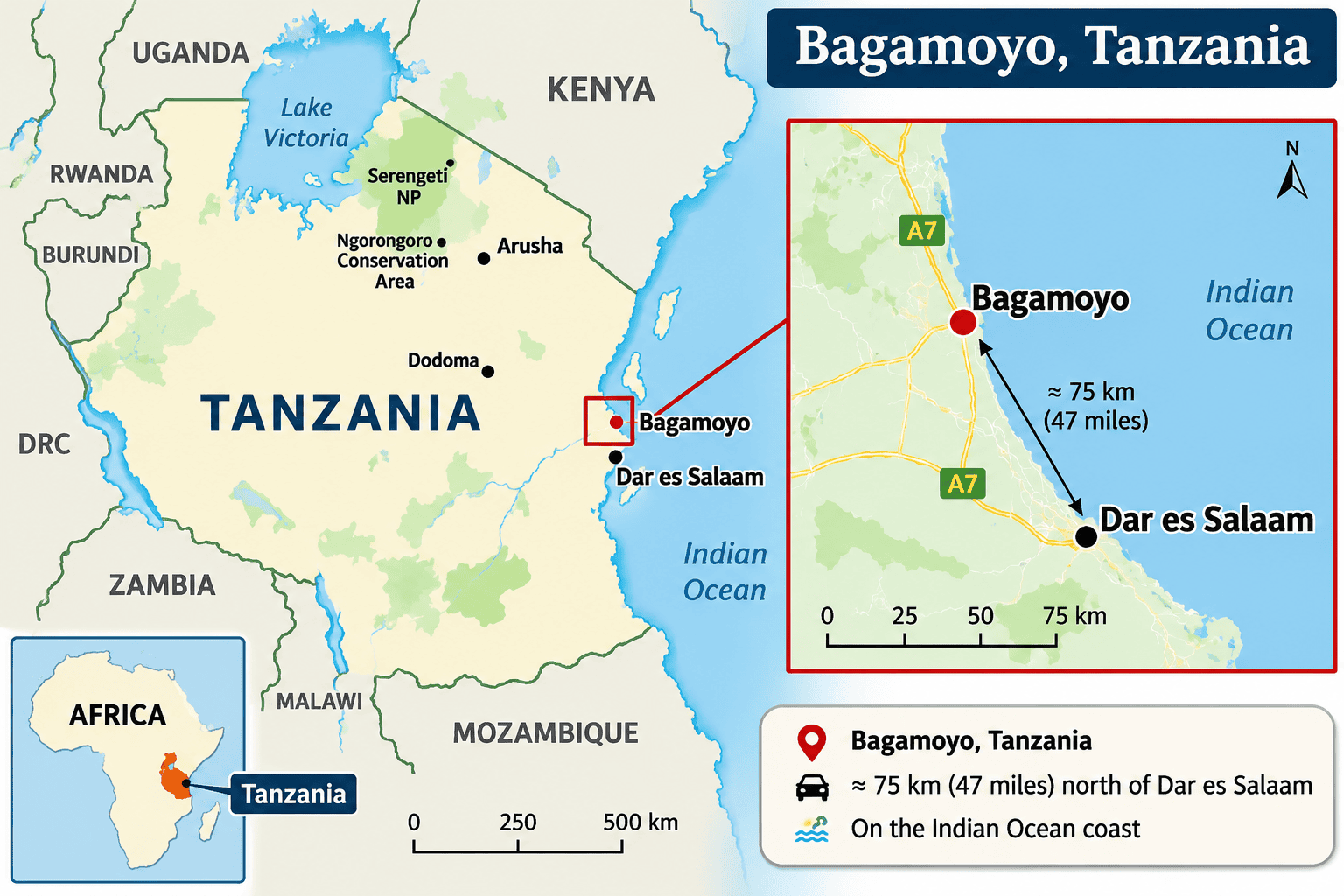
Bagamoyo is 75 kilometres north of Dar es Salaam, making it relatively accessible from Tanzania’s largest city.
The most straightforward option is to travel by road. You can hire a private driver, arrange a taxi or use local public transport. Buses and minibuses operate between Dar es Salaam and Bagamoyo. However, journey times vary considerably depending on traffic and the service you choose.
Allow additional time when travelling by road, particularly when leaving Dar es Salaam. Traffic congestion can make what appears to be a quick journey take much longer.
This is especially true at the moment. Tanzania is a joint host of the 2027 AFCON Cup football tournament, and a lot of infrastructure upgrade projects are underway.
If you are planning a day trip, I recommend arranging transport in advance so that you can make the most of your time in Bagamoyo.
Where to stay in Bagamoyo

Bagamoyo isn’t a big tourist town. It has a selection of guesthouses, hotels and beach accommodation, but the choice is more restricted and the quality lower than in Dar es Salaam or Zanzibar. Prices are, however, also lower. I paid about £10 for a basic room including breakfast. Whereas it wasn’t The Savoy, it was perfectly acceptable, clean, with air-con and usable Wi-Fi.
You can find accommodation in and around the town, as well as properties closer to the coast.
If your main interest is exploring the historic centre, staying within easy reach of the old town makes sense. If you would prefer somewhere quieter, consider accommodation along the coastline.
Given the limited accommodation offerings, I would recommend checking recent reviews. It’s also worth confirming transport arrangements before booking, particularly if you intend to visit Kaole or travel on to Saadani National Park.
How long should you stay in Bagamoyo?
How long you should spend in Bagamoyo depends on whether you are visiting as a day trip or incorporating it into a longer Tanzania itinerary.
A day trip from Dar es Salaam
Bagamoyo is an interesting alternative to spending another day in Dar es Salaam.
A day trip gives you enough time to explore the historic centre, visit some of its most important buildings and learn about its role in the East African slave and ivory trades.
Ideally, arrange a guided walking tour. Much of Bagamoyo’s history isn’t immediately obvious when wandering around independently, and having someone explain the significance of the buildings and locations makes a considerable difference.
You will also want to allow time for Kaole Ruins, which are a few kilometres outside the historic centre. It makes for a worthwhile day out, although you will need to plan your transport carefully to avoid spending too much of the day travelling.
Two or three days exploring Bagamoyo
I would recommend allowing at least two nights if you want to explore Bagamoyo properly.
This gives you time to visit the historic attractions without rushing, explore the coastline and mangroves, and experience something of everyday life in this relatively uncommercialised Tanzanian town.
It also gives you more opportunity to appreciate the town’s distinctive character rather than treating it simply as another stop on a Tanzania itinerary.
A Stopover en route to Saadani National Park
Bagamoyo also makes a useful stopping point for travellers heading north to Saadani National Park.
Rather than travelling directly from Dar es Salaam to Saadani, consider spending a night or two in Bagamoyo. You can explore the historic town before continuing your journey to the national park.
Bagamoyo and Saadani offer very different experiences. Combining the two makes an interesting addition to a coastal Tanzania itinerary.
Is Bagamoyo worth visiting?
Absolutely. Bagamoyo is one of Tanzania’s most interesting historic towns and deserves more attention from independent travellers.
It doesn’t have the polished tourist infrastructure of Zanzibar, nor does it offer the obvious attractions of Tanzania’s major safari destinations. Instead, its appeal lies in its history, architecture, coastal culture and relaxed atmosphere.
I particularly enjoyed exploring the historic centre with a local guide and visiting the Kaole Ruins. Both provided fascinating insight into the history of the East African coast.
Whether you visit on a day trip from Dar es Salaam, stay for a couple of nights or use it as a stopover on the way to Saadani National Park, I think Bagamoyo is well worth including in your Tanzania itinerary.
Latest Posts from Tanzania


Best Things to do in… Posts