

Is Ronda Worth Visiting? A Complete Guide
With so much competition in Andalucia from the likes of Malaga, Seville, Granada, and Cadiz, many people ask Is Ronda worth visiting?
Ronda is one of the most spectacular towns in southern Spain, dramatically perched above the El Tajo gorge in Andalucía. Famous for the extraordinary Puente Nuevo, its historic old town, Moorish architecture and spectacular mountain views, Ronda is much more than a place to stop for a photograph.
So, is Ronda worth visiting? Yes. I think Ronda deserves more than the few hours many visitors allow for a day trip. While you can see the main sights in a day, staying for two or three nights gives you time to explore the old town, discover its viewpoints, enjoy the local food and wine, and experience the town after the day-trippers have left.
I’ve visited Ronda as part of my travels around Spain and found that its appeal goes well beyond the famous bridge. In this guide, I’ll look at why Ronda is worth visiting, what you can see and do, how long you need, how to get there, where to stay and what Ronda is like for older travellers.
If you’re planning a trip through Andalucía, Ronda can also make an interesting contrast to the larger cities, combining dramatic scenery with a more relaxed historic-town atmosphere.
This travel guide will help you explore its most iconic sights, uncover hidden corners, and experience the city like a local.
The Do Not Go Gently Travel Blog uses affiliate links. If you make a purchase after clicking on one of these links, I may receive a small commission payment at no extra cost to you.
I first visited Spain as a 4 year old in the 60’s. I have returned countless times to the country I fell in love with all those years ago. My current trip is a month-long train odyssey using an interrail pass. These are the resources I used to plan my trip.
Hotels – Booking.com
Tours and Activities – GetYourGuide
Train Bookings – Rail Europe
Amazon Links
Travel Guide – DK Spain (Travel Guide)
Travel Guide – Slow Trains Around Spain
Ronda at a Glance
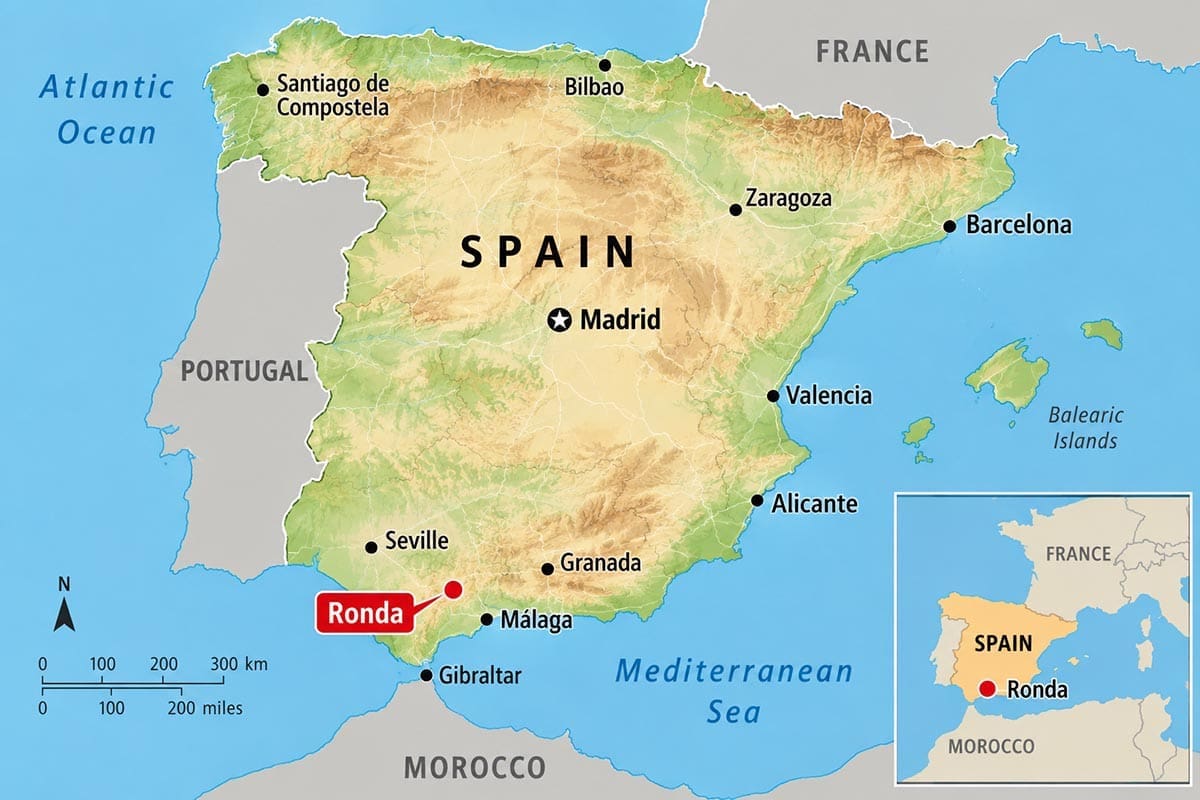
Ronda is a historic town in Málaga province, Andalucía, best known for its dramatic position above the El Tajo Gorge and the spectacular Puente Nuevo bridge. It is compact enough to explore on foot, although the cobbled streets, hills and steps can make some parts challenging for visitors with limited mobility.
| Feature | Ronda at a glance |
|---|---|
| Where is Ronda? | Málaga province, Andalucía, southern Spain |
| Famous for | Puente Nuevo, El Tajo Gorge, historic old town and mountain scenery |
| How long to stay | 2–3 nights for a more relaxed visit |
| Day trip? | Yes, although you will see less than if you stay overnight |
| Best time to visit | Spring and autumn for comfortable temperatures |
| Getting around | Mostly on foot, with some steep and uneven streets |
| Best for | Scenery, history, architecture, food and wine |
| Good for older travellers? | Yes, with some planning around hills, cobbles and steps |
Ronda’s compact centre makes it relatively easy to explore without a car, and many of its most important sights are close together. However, the town’s dramatic setting means that some of the best viewpoints involve slopes or steps. For older travellers, choosing accommodation in a convenient location and allowing plenty of time to explore at your own pace can make a big difference.
Why is Ronda Worth Visiting?

Puente Nuevo
The Puente Nuevo is Ronda’s most famous landmark and the sight that appears on almost every photograph of the town. Despite its name, the bridge dates from the 18th century and took over 40 years to complete.
It spans the El Tajo Gorge, connecting the older part of Ronda with the newer town. At around 98 metres above the gorge, it is an impressive piece of engineering as well as a spectacular viewpoint.
Don’t just photograph the bridge from the town. There are several viewpoints around Ronda offering different perspectives, while paths descend into the gorge for views looking back towards the bridge.
El Tajo Gorge
The dramatic El Tajo Gorge is what gives Ronda much of its character. The Guadalevín River has carved a deep gorge through the landscape, leaving the town dramatically positioned above it.
You can appreciate the gorge from viewpoints around the town, but walking down towards the gorge gives you a much better idea of its scale. The countryside around Ronda offers many trails. These range from simple walks to tougher hikes.
For me, the gorge is the main reason Ronda feels different from many other historic towns in Andalucía. The scenery isn’t simply something you look at from a viewpoint – it is an integral part of the town.
Ronda’s Old Town
Ronda’s old town, or La Ciudad, is a pleasure to explore on foot. Leave the busy area around Puente Nuevo and you’ll discover narrow streets, whitewashed buildings, small squares and historic houses.
One such highlight is Santa María la Mayor, the former mosque that was converted into a church after the Christian conquest. The surrounding streets contain some of Ronda’s most interesting historic architecture.
Take time to explore rather than simply ticking off the sights. Some of the best discoveries are the small squares, quiet streets, and viewpoints tucked between the major attractions.
History
Ronda has a long and varied history, with Roman, Moorish and Christian influences all leaving their mark on the town.
The Moorish period was particularly important, and several reminders remain, including the Arab Baths, the remains of the old city walls and the Mondragón Palace. The town’s position above the gorge also made it strategically important.
Ronda is also closely associated with the history of Spanish bullfighting. The Plaza de Toros is one of Spain’s oldest bullrings and is an important part of the city’s cultural history.
You don’t need to be particularly interested in bullfighting to appreciate Ronda’s historical significance. The combination of Roman, Islamic and Christian heritage makes exploring the town considerably more rewarding than simply visiting the bridge.
Food and Wine in Ronda
Ronda is also a wonderful destination for food and wine. The surrounding mountains and countryside produce extraordinary local ingredients. These drive the town’s restaurants, which serve traditional Andalusian dishes alongside more contemporary cuisine.
Wine enthusiasts will love the region. Vineyards around Ronda produce wines from several grape varieties, and wineries in the surrounding countryside offer tastings and tours.
To truly see Ronda, you need to stay a couple of nights. A day trip simply allows you to tick the highlights. Give yourself more opportunity to enjoy a relaxed meal and try some of the local wines.
The Views
Even if you did nothing more than stroll around Ronda looking at the scenery, you’d have plenty to enjoy. The town sits high above the surrounding landscape, with views across the mountains and valleys of Andalucía.
There are viewpoints around the gorge, along the old town and near the Alameda del Tajo. The scenery changes with the light, so staying overnight means you see Ronda in the early morning and late afternoon. The atmosphere is very different from the busiest part of the day.
This combination of dramatic scenery, history, architecture, food and wine is what makes Ronda worth more than a quick stop for a photograph of Puente Nuevo.
Why Might You Not Want to Visit Ronda?
Ronda has plenty to offer, but it isn’t necessarily the perfect destination for every traveller. Its popularity, dramatic location and hilly streets can create a few challenges, particularly if you are looking for a completely flat, quiet or easy-to-reach destination.
Day-Trip Crowds
Ronda is a popular day-trip destination, particularly from Málaga and other parts of the Costa del Sol. The old town and the area around Puente Nuevo isn’t designed for this volume and can feel overwhelming. The town can feel considerably more crowded when organised tours and day-trippers arrive.
This is one reason I would recommend staying overnight if you have the time. Early mornings and late afternoons tend to offer a more relaxed experience, and you’ll have much more time to explore beyond the main sights.
Hills and Cobbles
Ronda’s dramatic setting comes with a practical disadvantage: there are hills. Parts of the historic centre have cobbled streets, steps and uneven surfaces, while some of the viewpoints and routes down towards the gorge involve a significant amount of walking.
This doesn’t make Ronda unsuitable for older travellers, but it is worth considering if you have mobility difficulties. Comfortable footwear, allowing plenty of time and selecting accommodation in a convenient location can make your visit much easier.
I stayed at, Hotel Virgen de los Reyes, a pleasant two star, near the bullring. It meant I was close enough to the sights but in an area which was flat and paved.
Summer Heat
Andalucía can become extremely hot during the summer months, and walking around Ronda in the heat can be exhausting.
The advantage of Ronda’s elevation is that it can feel different from the coastal resorts. Even so, you should still plan longer walks for the cooler parts of the day, carry water, and take breaks. Spring and autumn are particularly pleasant times to explore on foot.
Ronda isn’t Easy to Get To
Ronda isn’t on Spain’s main high-speed rail network, and there is no airport in the town. Reaching it takes longer than getting to some of Andalucía’s major cities, particularly if you’re travelling by public transport.
These drawbacks don’t mean you should avoid Ronda. They are simply worth considering when deciding whether it fits your travel style. For me, the best way to experience Ronda is to allow enough time to explore it at a relaxed pace rather than treating it as a quick stop between other destinations.
Best Things To Do in Ronda
Puente Nuevo
Ronda’s defining image is without doubt the El Tajo Gorge. Slicing through the city, the gorge plummets to the River Guadalevín below. Ronda was once two separate towns, the gorge making travel between them difficult. Now, the stunning 98m high Puente Nuevo, a masterpiece of 18th century architecture joins the two towns by spanning the chasm.
To truly understand this architectural wonder, you’ll need to view it from different angles. While the view from the top is breathtaking, hike down the pathways beneath it to appreciate the sheer scale of its construction. If you’re feeling lazy, there’s a viewpoint halfway down. For the price of 5 euros, you can get magnificent views at https://desfiladerodeltajo.info/
Another option (best in the morning light) is the Old Bridge (16th century). I’d recommend visiting here as you can also see the even older Arab Bridge and the Arab baths while you’re at it (see below for more details on these),
Even if you visit Ronda for only one landmark, Puento Nuevo has the power to make the journey worthwhile.
Ronda’s Old Town: A Walk Through History
Walking across Puente Nuevo into La Ciudad, Ronda’s old Moorish quarter, is like travelling back in time. On one side are McDonald’s, souvenirs, and gelato; the other side offers a different vibe. Suddenly, you are walking on narrow cobbled lanes past whitewashed houses adorned with wrought-iron balconies and bursts of vibrant flowers. Here, you can feel the city’s layered history, shaped by Romans, Moors, and Christian Spaniards.
Palacio de Mondragón
The Mondragón Palace is a must-see, with its stunning Mudejar ceilings, tranquil courtyards, and mosaics reflecting its Moorish heritage. The palace gardens provide gorgeous views over the countryside—perfect for capturing that quintessential image of Ronda in Spain.
Arab Baths

Another essential site is the Baños Árabes, some of the best-preserved Moorish baths in the Iberian Peninsula. Built in the 13th century, these atmospheric ruins reveal how integral bath culture was in medieval Islamic society. First, watch the excellent video explaining the layout and how hot and cold water was pumped into the baths. Suitably educated, you can now explore the ruins illuminated by star-shaped openings in the ceiling.
The Old Walls and Gates
Exploring the old city walls is both scenic and educational. Wander through gateways such as Puerta de Almocábar, a reminder of the fortifications that once protected the Moorish town. Ronda was such a formidable fortress that it was the last city recaptured from the Moors.
Puente Viejo and Puente Árabe: Ronda’s Other Historic Bridges

Puente Nuevo features on most of the Ronda postcards, but it isn’t the only bridge to see.
Two older bridges. Puente Viejo (the “Old Bridge”) and Puente Árabe (the “Arab Bridge”) offer a gentler and equally beautiful way to appreciate the geological drama of Ronda in Spain.
These bridges cross quieter, more secluded sections of the gorge and provide a softer atmosphere compared to the grandeur of Puente Nuevo. They’re also less likely to be jammed with day trippers. Walking across them, you’re treated to picturesque views of stone walls, small waterfalls, and lush vegetation. They also make excellent starting points for hikes into the surrounding countryside.
Plaza de Toros: The Soul of Spanish Tradition:

No visit to Ronda in Spain is complete without stepping into the Plaza de Toros, one of the oldest and most revered bullrings in the country. Even if you prefer not to watch bullfighting, the arena itself is a masterpiece of Andalusian architecture.
Built in 1785, it features elegant archways, a sandy arena bathed in golden light, and a museum that traces the cultural significance of the Spanish bullfighting tradition.
One of the town’s most famous sons, Pedro Romero is considered by many to be the father of modern bullfighting and is credited with developing it into an art form. These days, Ronda only holds bullfighting during the festival in September, which bears his name. (They didn’t hold the festival in 2025 because the bullring was under renovation, but they plan to reinstate it in 2026).
Discover Ronda’s Links to Art, Literature, and Legends
The artistic and literary heritage of Ronda in Spain is woven into its streets. The city’s scenery and atmosphere have inspired some of the world’s most acclaimed creatives. The most famous of these are Ernest Hemingway and Orson Welles, both of whom spent considerable time here.
Welles was a great friend of Ronda’s other legendary matador, Antonio Ordóñez, and spent a significant amount of time in the city. His ashes rest on the Ordóñez property outside the city.
A sculpture of the heads of both Welles and Hemmingway stands near the bullring and leads to the matador walk of fame.
Explore Ronda’s Natural Surroundings
While the city itself is rich with cultural treasures, the surrounding countryside offers incredible opportunities for outdoor adventure. The region around Ronda in Spain is wonderfully diverse, with rolling hills, craggy cliffs, vineyards, and traditional white villages.
Hiking Routes around Ronda
Popular routes include:
- Camino de los Molinos, a scenic walk that takes you to the base of the gorge and rewards you with panoramic views of Puente Nuevo.
- The Tajo del Abanico, a narrow rock formation resembling a fan, set amongst tranquil woodland.
- Trails leading to nearby villages such as Benaoján and Montejaque, perfect for those seeking longer treks.
Cycling Trails around Ronda
Cycling enthusiasts will find Ronda an excellent base. Varied terrain, rewarding climbs, and quiet rural roads offer glimpses of traditional Andalusian life.
Horse Riding and Adventure Sports
You can go horse riding in the mountains with guides from local stables, or try rock climbing, canyoning, or hot-air ballooning over the Ronda plateau if you’re feeling adventurous.
Wine Tasting in Ronda
The area around Ronda in Spain is an up-and-coming wine region, producing bold reds and fresh whites that surprise many travellers. The fertile soils and mild microclimate make it ideal for wine producing, and local wineries welcome visitors for tastings and tours.
Notable estates include:
- Bodega Doña Felisa, famous for its Chinchilla wines.
- Joaquín Fernández, an organic bodega offering tastings paired with local tapas.
- F. Schatz, one of the earliest biodynamic wineries in Spain.
Wine tasting in Ronda offers a more relaxed experience compared to the larger wine regions. It is a wonderful way to spend an afternoon, surrounded by vineyards and dramatic mountain views.
Food: The Flavours of Ronda in Spain
Food is central to any trip to Ronda in Spain. The city’s cuisine blends traditional Andalusian flavours with modern influences. Locally sourced ingredients such as olive oil, cured meats, goat’s cheese, and seasonal produce are showcased by the city’s restaurants.
What to Eat in Ronda:
- Rabo de toro (oxtail stew) slow-cooked to tender perfection.
- Salmorejo, a creamy tomato and garlic soup ideal for warm afternoons.
- Chivo lechal, roasted suckling goat, a local speciality.
- Tapas such as croquetas, garlic mushrooms, and Iberian ham.
Ronda also produces excellent olive oil. Take a tour to the olive oil museum for an exploration into all things olive and some tastings.
Where to Eat in Ronda:
- Las Maravillas Tapas, a lively tapas bar frequented by locals.
- Restaurante Pedro Romero, a traditional eatery filled with bullfighting memorabilia.
- Tragata, offering modern Andalusian dishes with creative flair.
- Albacara Restaurant, great views, try the ceviche and suckling pig.
After dinner, stroll through the peaceful streets, stopping at a terrace bar for a glass of Ronda red while watching the sunset over the gorge. One of the most memorable experiences you can have in this magical city.
The Best Viewpoints in Ronda
Ronda’s topography means there are spectacular viewpoints everywhere.
Mirador de Aldehuela
Located near Puente Nuevo, this balcony-like viewpoint offers sweeping views of both the gorge and the countryside beyond.
Jardines de Cuenca
Terraced gardens descend along the side of the gorge, providing multiple levels from which to appreciate the bridge and river below.
Mirador de Ronda
A wide-open viewpoint offering unobstructed panoramas of the Serranía de Ronda. It’s also a popular place for musicians, artists, and sunset gatherings.
Balcón del Coño
Perhaps the most dramatically named viewpoint in Spain. Legend has it, visitors exclaimed “¡Coño!” (the Spanish equivalent of “Oh my God!” (it has other translations not suitable for a family blog!) when seeing the sheer drop for the first time. The name stuck.
Restaurante Panoramico
A restaurant on the top floor of the Hotel Catalonia Ronda. Take the lift to the 4th floor for a coffee with a great aerial view of the bullring and the mountains behind.
Each viewpoint shows a new angle of Ronda in Spain, emphasising just how unique and awe-inspiring the city is.
Festivals and Cultural Events in Ronda

Ronda’s cultural calendar is lively and deeply rooted in tradition. If your visit coincides with one of the city’s festivals, you’re in for a treat.
Ronda Romántica (May)
Locals celebrate the city’s romantic 19th-century past with parades, period costumes, horse-drawn carriages, and open-air concerts.
Feria de Pedro Romero (early September)
A vibrant festival honouring the legendary bullfighter Pedro Romero. Expect flamenco shows, traditional dress, a spectacular parade, and lively street parties.
Semana Santa (Holy Week)
Beautiful processions wind through the old town, featuring ornate floats carried by dedicated brotherhoods.
Experiencing a festival in Ronda in Spain, offers a deep sense of connection with Andalusian culture and community spirit.
Day Trips and Nearby Villages from Ronda
Ronda is a perfect base for exploring some of the most beautiful parts of Andalucía. Within an hour’s drive, you can reach several idyllic white villages, known as pueblos blancos, as well as natural parks and historic towns.
Setenil de las Bodegas
Famous for houses built beneath huge rock overhangs, Setenil feels otherworldly.
Grazalema

A charming village surrounded by a lush natural park, ideal for hiking and birdwatching. Look for the Spanish fir, one of the oldest evergreen species in the world, and the majestic Griffin Vulture soaring above you.
Zahara de la Sierra
Perched above a turquoise reservoir, Zahara boasts a castle with breathtaking views.
Júzcar
The “Blue Village”. Until 2011, Juzcar was a traditional white-painted Andalusian village. A publicity company persuaded the inhabitants to let them paint the town blue for the premiere of “Smurfs 3D”. They must have liked it, the place is still coloured Smurf blue!
Each of these destinations provides a unique perspective on life in rural Andalucía, making your trip to Ronda in Spain even more enriching.
How Long Do You Need in Ronda?
You can see the main sights of Ronda in one day, but I would recommend staying for two or three nights if you have the time. A day trip allows you to see Puente Nuevo, the gorge and the historic centre, but an overnight stay gives you more time to explore at a relaxed pace and experience Ronda after many of the day-trippers have left.
One Day in Ronda
If you’re visiting Ronda as a day trip, concentrate on the main sights. You should have enough time to see Puente Nuevo and El Tajo Gorge, explore the old town, visit one or two historic attractions, and enjoy the views around the town.
It will be a fairly full day, particularly if you are walking between the different parts of Ronda. If you’re travelling as an older visitor, I would avoid trying to squeeze too much into the day and allow time for stops and refreshments.
Two Days in Ronda
Two days is a good length of time for a first visit. You can see the major sights without rushing and have time to explore some of the attractions that are easy to miss on a day trip.
As well as Puente Nuevo and the old town, you could visit the Arab Baths, Mondragón Palace and Plaza de Toros, spend some time at the viewpoints and enjoy a relaxed evening meal.
Three Days in Ronda
A three-day stay gives you the opportunity to slow down and explore beyond the major attractions. You could take a walk into the surrounding countryside, visit a winery, or explore some of the smaller towns and villages around Ronda.
This would be my choice if Ronda is part of a longer Andalucía trip and you want to use it as a base rather than simply stopping for the famous bridge.
My Recommendation
For most visitors, two nights is the sweet spot. One night gives you a chance to see Ronda without rushing, while two nights allows you to explore more thoroughly and enjoy the town at a slower pace.
If you’re travelling independently and particularly if you’re an older traveller, I’d favour two or three nights rather than a day trip. Ronda’s hills and cobbled streets mean that exploring slowly is much more enjoyable than trying to cover everything in a few hours.
Is Ronda Suitable for Older Travellers?
Ronda is a good destination for older travellers who enjoy history, scenery, food and exploring at their own pace. It is a relatively manageable town for an independent visit, with many of the main attractions concentrated around the historic centre.
One of the things I particularly like about Ronda for older travellers is that you don’t need to spend your whole day sightseeing. You can visit an attraction in the morning, stop for lunch, sit in one of the town’s squares or viewpoints, and then continue exploring later.
Why Is Ronda a Good Destination for Independent Travellers
Ronda doesn’t require an organised tour to enjoy it. The historic centre is straightforward to explore independently. Most of the main attractions are close together, so you can choose what you want to visit. There are plenty of cafes, restaurants and places to stop along the way, making it easy to build in plenty of breaks into your day.
You Don’t Need to See Everything
Ronda is particularly well suited to travellers who prefer slow travel rather than rushing from one attraction to another.
You can cover the main sights in a day, but staying for two or three nights lets you spread out your sightseeing. With an extended visit, you can explore the historic centre one day and enjoy local food, wine, or the countryside the next.
Ronda is Good for History and Culture
If you enjoy history, Ronda has plenty to offer without requiring you to spend hours in large museums. The old town, Arab Baths, Mondragón Palace, city walls and Plaza de Toros all tell different parts of the town’s story.
This makes Ronda a good choice if you prefer experiencing a destination rather than simply collecting a list of attractions.
Travelling to Ronda as an Older Visitor
For an independent older traveller, I would treat Ronda as a place to slow down rather than squeeze into an already busy Andalucía itinerary.
Arrive, find your accommodation, and explore at your own pace. Ronda is much more enjoyable explored slowly than trying to see everything before your bus leaves for the next destination.
My main advice is to give Ronda enough time. Two nights provide a comfortable introduction. Three nights allow you to enjoy the town and its surroundings without rushing.
How to Get to Ronda
Ronda is inland in the mountains of Málaga province, so getting there takes a little more planning than reaching the major cities of Andalucía. There is no airport in Ronda, but the town has both a railway station and a bus station, and it is possible to arrive by public transport from Málaga, Seville and other destinations.
Getting to Ronda by Train
For me, the train is one of the most pleasant ways to reach Ronda, particularly if you’re travelling independently. Ronda railway station is on Avenida de Andalucía, and it has both long-distance and regional services. The station has a taxi rank, parking and assistance for passengers with accessibility needs.
There are train services between Malaga and Ronda, and Renfe currently lists Ronda as a destination from Malaga.
The journey is scenic as you leave the coast and head into the mountains. However, train services are not especially frequent, so check the timetable before planning your day around a particular departure.
When I last visited Ronda, I was travelling around Spain on an interrail pass. I caught the train from Malaga and changed at Antequera. The journey took approximately two hours.
Getting to Ronda by Bus
Buses can be a useful alternative, particularly if you’re travelling from places where the train isn’t convenient. Ronda’s bus station is on Plaza Concepción García Redondo, close to the centre of town.
Buses connect Ronda with Malaga and other towns in Andalucía. If you’re travelling independently, compare the train and bus timetables rather than assuming the train will always be the quickest option.
Driving to Ronda
Having a car gives you the greatest flexibility, particularly if you want to explore the countryside around Ronda or visit some of the white villages.
The roads through the mountains can be winding, so allow more time than you might expect from the distance on a map. Before booking, check your accommodation’s parking arrangements. Some hotels have parking, while others rely on nearby public car parks.
If you’re planning to spend most of your time in Ronda itself, however, you don’t need a car once you’re there. The historic centre is best explored on foot.
From Malaga
Malaga is one of the most convenient starting points for Ronda. You can travel by train or bus, while organised day trips also operate from Malaga. The journey takes you inland from the Costa del Sol into the mountains.
If you are flying into Malaga–Costa del Sol Airport, you can first travel into Malaga and continue to Ronda from there. Malaga’s María Zambrano station has rail and public transport connections, including direct links to the airport.
From Seville
Ronda can also be incorporated into a journey between Seville and Malaga, making it a useful stop if you’re touring Andalucía by public transport.
There are train and bus connections, although journey times and services vary, so check the current timetable when planning your trip. If you are driving, Ronda can be incorporated into a wider road trip through the white villages and mountain areas of Andalucía.
Which Is the Best Way to Get to Ronda?
For an independent traveller, I’d consider train or bus first, depending on the timetable that fits your itinerary. Driving is preferable if you want to explore beyond Ronda, but it isn’t necessary for visiting the town itself.
If you’re an older traveller, I’d also consider where you’re staying when choosing your arrival method. Arriving by train or bus with luggage can involve a walk or taxi journey to your accommodation, so check the location of your hotel before booking your transport.
Where to Stay in Ronda
There are two main options when choosing where to stay in Ronda. Basically, you stay in the Old Town or the New Town, and they both have their advantages and disadvantage.
Staying in Ronda’s Old Town
The Old Town, known as La Ciudad, is the more atmospheric choice. This is where you’ll find many of Ronda’s historic buildings, narrow streets and some of its most interesting sights.
Staying here means you’re close to attractions such as Santa María la Mayor, Mondragón Palace and the Arab Baths, while Puente Nuevo and the gorge are also within easy walking distance.
The main advantage is the atmosphere. Once the day-trippers have left, the Old Town becomes much quieter and you can enjoy wandering its streets and having dinner locally.
The disadvantage is that some of the streets are narrow, steep or cobbled, and some older buildings don’t have lifts. If you have mobility issues, check the hotel’s location and facilities carefully before booking.
Click here for accomodation options in Ronda’s Old Town
Staying in the New Town
The New Town, around the area north of Puente Nuevo, is generally more practical. There are plenty of shops, cafés, restaurants and hotels, and the streets tend to be easier to navigate.
It can be a particularly good option if you’re arriving by train or bus, or if you prefer having everyday facilities close by. You’ll still be within walking distance of Puente Nuevo and the Old Town.
The New Town doesn’t have quite the same historic atmosphere, but that can be an advantage if you want a more straightforward base. Accommodation can also offer better access for travellers who prefer modern hotels with lifts and more spacious rooms.
Click here for accomodation options in the New Town
Which Area Should You Choose?
For atmosphere and history, I’d choose the Old Town. For convenience and easier access to modern facilities, the New Town may suit you better.
For older travellers, I’d put the location and accessibility of the individual hotel ahead of whether it is technically in the Old or New Town. A hotel with a lift, a comfortable room and an easy route to the main sights can make a bigger difference to your stay than the neighbourhood itself.
Best Time to Visit Ronda
When to Go:
- Spring (April–June) and autumn (September–October) are the most pleasant seasons, offering warm temperatures without overwhelming heat.
- Summer can be very hot but ideal for late-evening strolling and outdoor dining.
- Winter brings crisp air and quiet streets, perfect for a peaceful retreat.
Day Trips from Ronda
Day Trips from Ronda
Ronda is possible to use as a base for exploring the surrounding Andalucía countryside, but I wouldn’t choose it primarily for day trips. The nearby white villages and mountain landscapes are much easier to explore if you have your own car, and organised excursions from Ronda are less common than those departing from larger tourist centres such as Málaga or Seville.
If you’re travelling by public transport, connections to some of the smaller villages can also be limited and may make a day trip surprisingly time-consuming.
For most visitors, I think Ronda works better as a destination in its own right. Rather than spending one of your limited days travelling elsewhere, allow yourself time to explore the town, its historic attractions and the countryside immediately around it.
If you have a car and are staying for three or more nights, however, Ronda makes a useful base for exploring some of the white villages and mountain scenery of the Serranía de Ronda and Sierra de Grazalema.
So, unless you have a particular attraction or village you want to visit, I wouldn’t build your Ronda itinerary around day trips. Give Ronda the time it deserves first, and treat the surrounding countryside as an extra rather than the main reason for staying.
Final Thoughts: Is Ronda Worth Visiting?
So, is Ronda worth visiting? Absolutely. Its spectacular setting above the El Tajo Gorge, the extraordinary Puente Nuevo, historic old town and surrounding Andalusian countryside make it one of the more memorable places to visit in southern Spain.
What I particularly like about Ronda is that there is more to the town than its famous bridge. You can spend time exploring its history, wandering through the old streets, enjoying the views, and sitting down to a relaxed meal or a glass of local wine.
It does have its drawbacks. Ronda can be busy during the middle of the day, the terrain isn’t ideal for everyone, and reaching it takes longer than getting to Andalucía’s major cities. But these are good reasons to plan your visit carefully rather than reasons to leave Ronda off your itinerary.
If you can, I’d recommend staying for at least two nights. That gives you time to see the main sights without rushing and, importantly, to experience Ronda when the day-trippers have gone.
For me, Ronda is somewhere to slow down and enjoy rather than simply photograph. If dramatic scenery, history, architecture and traditional Andalucía appeal to you, it deserves a place on your itinerary.
Latest Posts from Spain


