
Are There Trains in Indonesia? The Complete Rail Travel Guide (2026)
Many people exploring Indonesia as a potential travel destination ask, ‘Are there trains in Indonesia?’.
Yes, there are trains in Indonesia, and travelling by train can be one of the best ways to explore Java. Indonesia doesn’t have a nationwide railway network connecting all of its islands, but Java has an extensive and comfortable long-distance rail network, with a smaller network also operating in Sumatra.
Remembering that Indonesia is an archipelago of 17000 islands, 6000 of which are inhabited, it’s not reasonable to expect a comprehensive train system. There is, however, a high-quality train service covering the main island of Java and, to a lesser extent, Sumatra.
This guide will tell you everything you need to know to answer the question, ‘Are there trains in Indonesia?’ It will tell you how to travel by train through this wonderful country.
Caveat: This blog post covers long-distance regional train travel. It doesn’t cover commuter trains around Jakarta, Yogyakarta, and Surabaya.
The Do Not Go Gently Travel Blog uses affiliate links. If you make a purchase after clicking on one of these links, I may receive a small commission payment at no extra cost to you.
I recently spent two months travelling through Indonesia and Malaysia. When researching and planning the trip, these are the main resources I used.
Hotels – Booking.com
Tours and Activities – GetYourGuide
Travel Guide – Lonely Planet – Indonesia (Amazon)
Indonesia Train Travel at a Glance

| Question | Answer |
|---|---|
| Are there trains in Indonesia? | Yes. Indonesia has an extensive railway network on Java, with smaller networks operating in parts of Sumatra. |
| Which island is best for train travel? | Java is by far the best island for long-distance train travel, connecting many of Indonesia’s major cities and tourist destinations. |
| Who operates the trains? | KAI (Kereta Api Indonesia) operates most conventional passenger trains. The Whoosh high-speed railway is operated separately. |
| What is the high-speed train? | Whoosh is Indonesia’s high-speed railway, connecting Jakarta and Bandung in around 45 minutes. |
| Which class is best for comfort? | Executive Class offers a good combination of comfort and value, particularly on longer journeys. |
| Can foreign visitors book train tickets? | Yes. Foreign visitors can book Indonesian train tickets online or through booking platforms, using their passport details. |
| Are Indonesian trains suitable for senior travellers? | Yes. The trains can be comfortable, although accessibility varies between stations. Executive Class and allowing extra time can make journeys easier. |
Indonesia is a large country, and its island makeup means it also has a popular network of plane travel. Whereas flying between towns can save time, it doesn’t offer the soft advantages of train travel.
Travelling by train in Indonesia takes away the stress of airport security, hand luggage limits and cramped seating. It allows you to see more of the country’s stunning scenery.
Whereas flying may look quicker on paper, it depends on the length of the journey. Airports are usually out of town and require check-in a couple of hours ahead of the flight. Getting on a train has a far lower time overhead, which eats into the advantage of flights.
Where Can You Travel by Train in Indonesia?
Indonesia’s railway network is concentrated mainly on Java, with a much smaller network in parts of Sumatra. This means you can’t travel by train between all of Indonesia’s major tourist destinations, but trains are an excellent option if you’re travelling around Java.
For a first trip to Indonesia, I’d therefore think of Java as the country’s main train-travel destination, rather than trying to use trains throughout the whole country.
Travelling by Train in Java
Java is by far the best island for train travel in Indonesia. The railway connects many of the island’s major cities, including Jakarta, Bandung, Yogyakarta, Solo and Surabaya.
For travellers, this makes it possible to build a trip around the railway rather than relying on internal flights. A popular route is Jakarta–Bandung–Yogyakarta–Solo–Surabaya, although you can choose individual sections depending on your itinerary. If you’re planning a tour of Indonesia, you may be interested in this 15 day Bali to Java itinerary. I wrote it after spending an extended period travelling around Indonesia.
The railway also makes it relatively easy to combine Java with a trip to Bali. Trains run eastwards towards Ketapang, the port at the eastern end of Java. From here, you can take the short ferry crossing to Gilimanuk in Bali.
If you’re considering including Bali in your visit to Indonesia, read my post Is Bali worth Visiting. Another interesting thing to do when on Bali is to visit the Komodo National Park, home to the world’s largest lizards
This is one of the reasons I particularly like travelling around Java by train. You can see much more of the countryside than you would from an aircraft, while avoiding the long road journeys that can be involved in travelling by bus or car.
Travelling by Train in Sumatra
Sumatra also has passenger trains, but the network is much smaller and less useful for most first-time visitors than the railway on Java.
Rail services operate in parts of southern Sumatra, including routes around Palembang and Bandar Lampung, while other services operate in northern Sumatra. However, the railway doesn’t provide a continuous network across the island.
If your Indonesia itinerary concentrates on places such as Medan, Lake Toba or Bukittinggi, trains are therefore less likely to be the main way you travel between destinations.
Are there Trains in Bali?
Bali does not currently have a conventional passenger railway network, so you cannot take a train around the island.
If you’re travelling from Java to Bali, however, the combination of train to Ketapang and ferry to Gilimanuk is a useful alternative to flying. From Gilimanuk, you’ll need onward road transport to reach other parts of Bali.
How to Book Train Tickets in Indonesia
Foreign visitors can book Indonesian train tickets online, although the process isn’t always as straightforward as booking a UK train. KAI is the national railway operator, while third-party booking platforms such as Tiket.com can also be used.
The best method of booking trains is Tiket. They are an agency that links to KAI’s website. As well as their website, they have a very user-friendly app for phone bookings. You can also purchase tickets at stations, although pre-booking on many trains is a good idea. You’ll also need to show a passport for each traveller.
Indonesian Train Travel Classes
Indonesian Train Travel Classes at a Glance
| Class | Indonesian / Booking Term | Best For | What to Expect |
|---|---|---|---|
| Economy | Ekonomi | Budget travellers | The cheapest option, with comfortable seating for shorter journeys. Some services can be busy. |
| Executive | Eksekutif | Most travellers wanting extra comfort | More spacious seating and a quieter, more comfortable environment. A good choice for longer journeys. |
| Luxury | Luxury | Travellers wanting maximum comfort | Premium seating and a more exclusive experience, available on selected services and routes. |
| Panoramic | Panoramic | Travellers who want to enjoy the scenery | Large windows and panoramic views make this particularly appealing on scenic journeys. Seats are limited and it is only available on selected trains. |
The trains in Indonesia have two basic travel classes, although all three may not be available on specific trains. There is a third (Bisnis), but it’s being phased out, so ignored for the purposes of this post.
Ekonomi Class
KAI’s Ekonomi class is a more budget-friendly, but still perfectly acceptable option. The carriages are air-conditioned with padded seats. The seats don’t, however, have the reclining options of the premium-class carriages.
Most Ekonomi class carriages feature a 2+3 seating format. These are arranged in groups of 4 or 6, facing each other. This is like the seating arrangements on UK trains. The pods have two electric sockets (European two-pin) and a small tray table attached to the carriage wall.
Recently, KAI has rolled out more modern carriages in a front-facing 2+2 format. The seats in these carriages have better padding and recline. Along with power sockets, they additionally have USB charging.
When you book, check the seat map. If it shows the 2+2 format, the train is running new-generation carriages. If this is the case, the upgrade to Eksekutif class probably isn’t worth it unless you want the extra legroom.
Refreshments are available in the buffet car, which is usually a feature on all long-distance trains in Indonesia.
Eksekutif class (EKS)
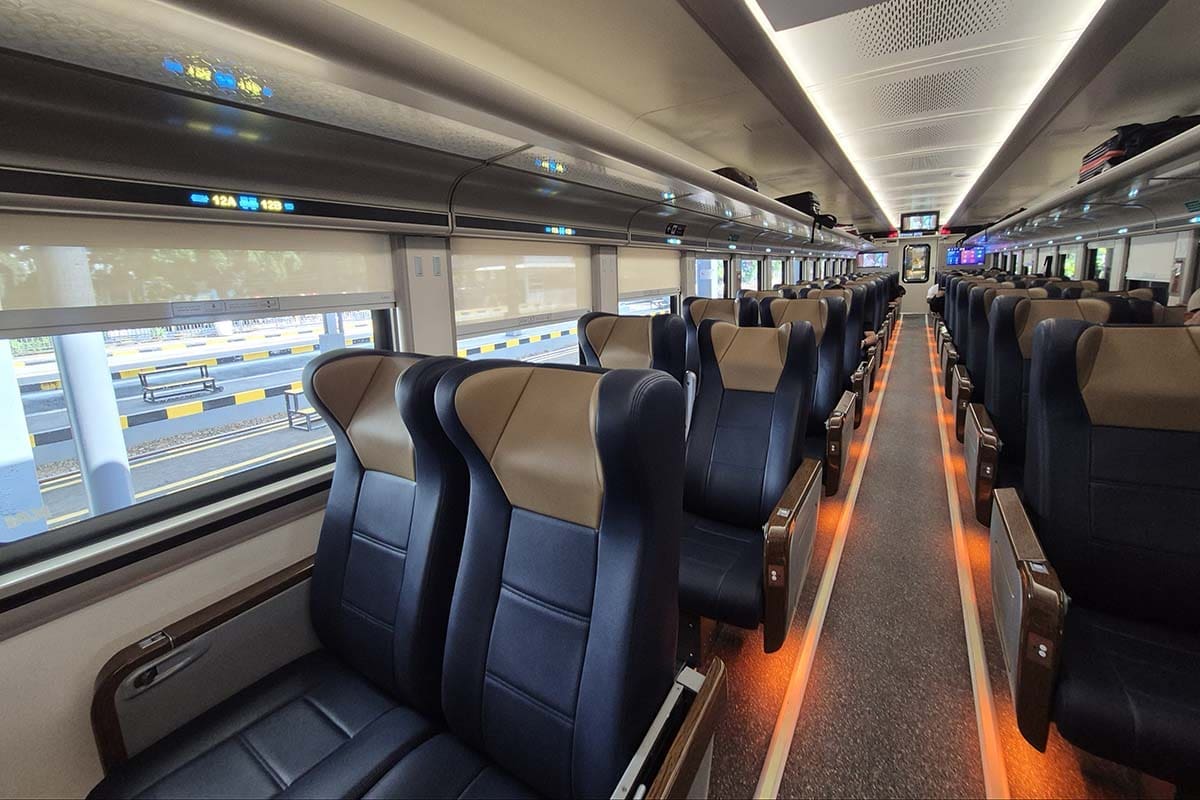
The premier class, but with varying standards depending on the age of the train. EKS seats are laid out in a front-facing 2+2 format. An upgrade from Ekonomi seats, they recline. Some rotate 90 degrees to both the window and the aisle, and have power sockets (European 2-pin style).
The sockets are usually at floor level, and can be difficult to plug devices into without getting down on your knees.
Most now have an airline-style tray table embedded in the seat’s armrest. This is, however, quite flimsy and small for laptop use.
Some trains have an upgraded Eksekutiv Car. These offer more luxurious seats with almost 180-degree recline. They’re laid out in a 2+1 format, so if you’re travelling alone, you can choose the single seats when booking.
Some routes have even more luxurious offerings. The Eksekutiv Sleeper car offers lie-flat beds of the sort you’d find in the premium cabins on planes. The ultimate, however, is the Eksekutiv Luxury Suite, offering a totally isolated train experience via a closed-off seating area.
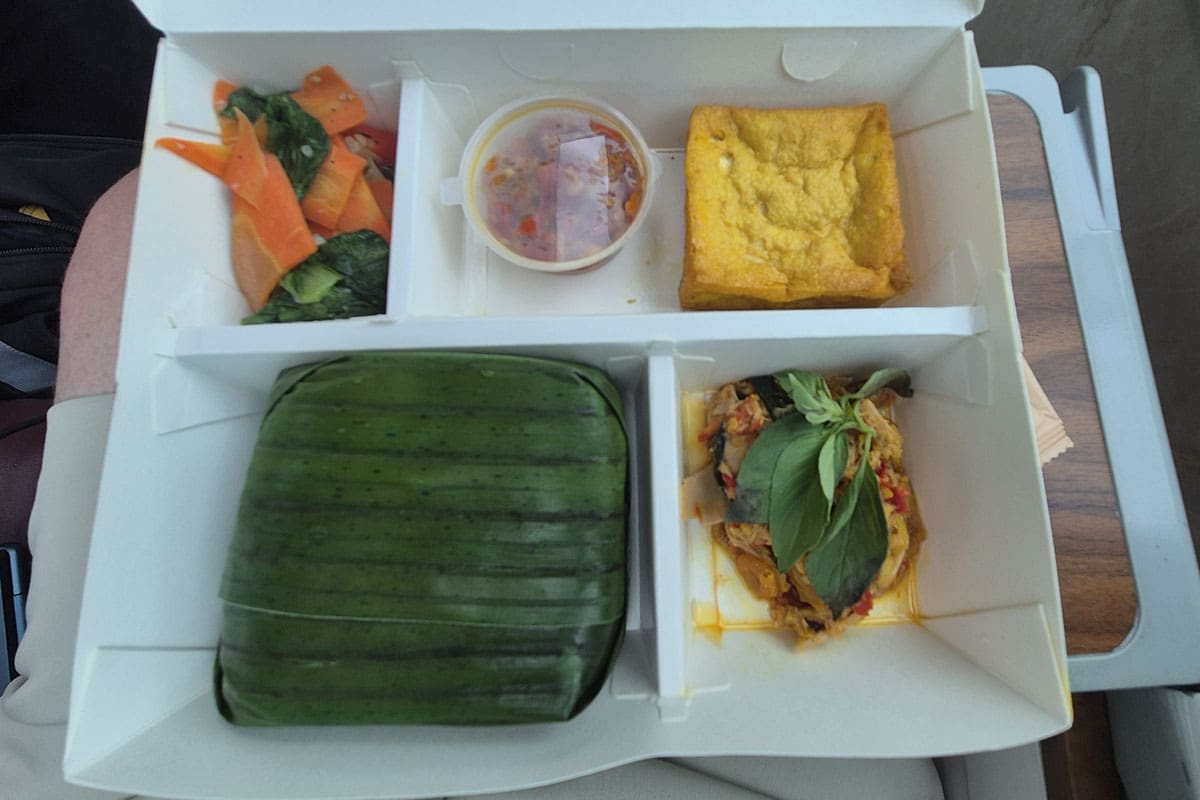
Most EKS tickets include food, which is delivered to your seat. A refreshment cart offering (paid) hot drinks and snacks will come through the carriages regularly. KAI trains usually have a buffet car if you can’t wait.
Indonesian Panoramic Trains: Are They Worth It?

One other form of Eksekutiv car worth mentioning is the panoramic car. These premium cars only run on certain routes.
There will only be one panoramic carriage on a train, so when you book, look specifically for the carriage designation.
This travel class is quite exclusive and only has 38 seats, so book early. The panoramic carriage features large side windows, a panoramic roof, complimentary food and drinks, and extra legroom. The seats have European pin electrical sockets, and turn 90 degrees to allow you to sit facing the window. Although a bit more expensive, for me, the panoramic carriage was the most enjoyable way to see the Indonesian countryside by train..
The best routes to travel in a panoramic carriage are:
Bandung → Yogyakarta on the Argo Wilis or Turangga
- Rice terraces, volcanoes, and river valleys.
- The spectacular crossing of the Cikuray and Priangan highlands.
- Widely regarded as the most scenic train journey in Indonesia.
Jakarta → Bandung on the Parahyangan
- Mountain scenery begins shortly after Jakarta.
- Excellent views around Purwakarta and the Cisomang Valley.
Surabaya → Ketapang
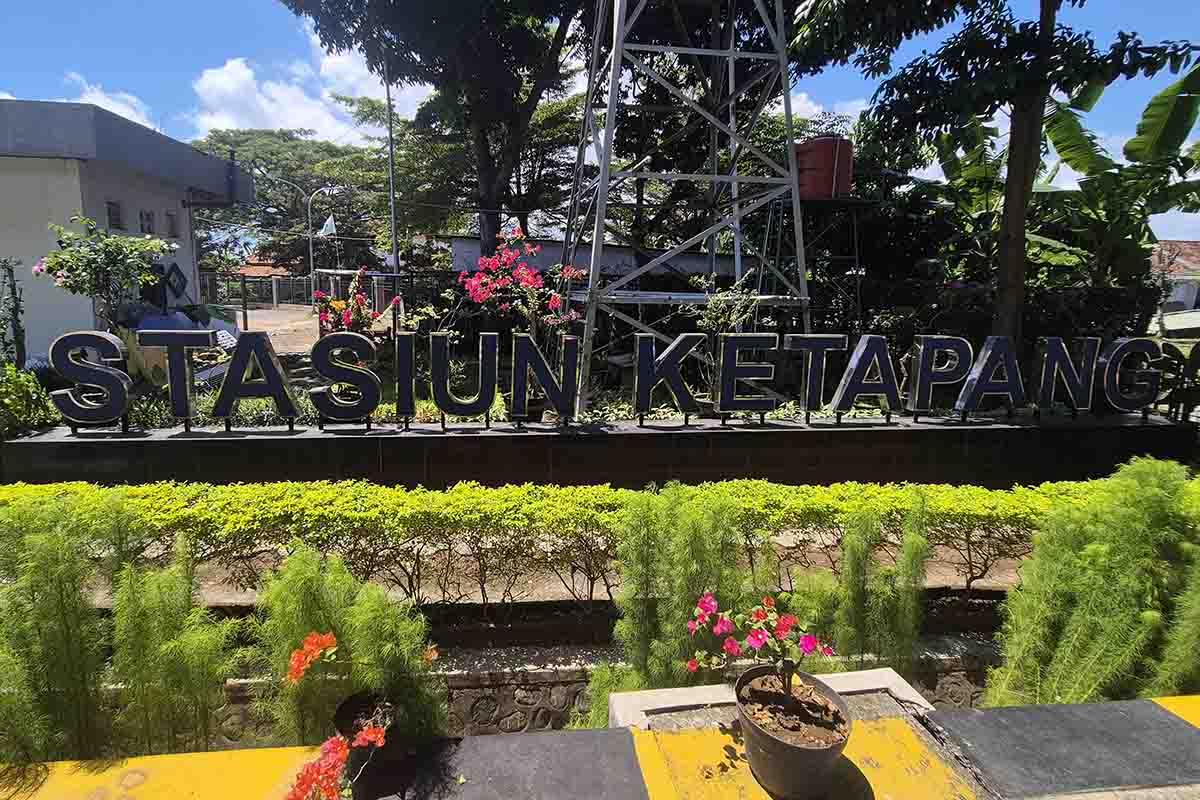
- Views of East Java volcanoes and rural landscapes.
- Convenient if you’re continuing to Bali by ferry.
If forced to recommend just one journey in the panoramic carriage, it would be the Bandung to Yogyakarta (or vice versa) route. The scenery through the highlands is spectacular.
The Whoosh High Speed Train

The jewel in the crown of Indonesian train travel. The Whoosh ‘flies’ between Jakarta and Bandung, cutting the three-hour journey to a mere 45 minutes.
KAI introduced the high-speed bullet train, the fastest in southeast Asia in 2023. It currently only operates between the capital and Bandung, plans are being discussed to extend it to Surabaya.
Be aware that if you select this train (and you should), the stations are outside the city centres, so allow time for your onward journey.
Luggage on KAI Trains in Indonesia
The limit for luggage on KAI trains is 20kg. Store larger suitcases behind the last seats in the carriage. Backpacks and smaller bags will fit in an overhead compartment or at your feet.
If your luggage is over the allowance, the published excess baggage charges are relatively modest. In six train journeys around Java, my luggage was never weighed. I wouldn’t rely on that being the norm though.
Excess Luggage Prices – 2026
- Executive Class – Rp 10,000 (41 pence) per kg.
- Economy Class – Rp 2,000 (8 pence) per kg.
Do Indonesian Trains have Wi-Fi
Yes, Indonesian trains have Wi-Fi, but the nature of the geography means it’s slow and sporadic.
At best, you’ll be able to receive and send emails, or surf websites. It’s very unlikely to be strong enough for streaming outside of built-up areas. Most Indonesians rely on their phones when travelling by train.
The Whoosh train service advertises Wi-Fi, but when I travelled between Bandung and Jakarta, I couldn’t find it. When I asked the stewardess, she said there wasn’t Wi-Fi.
I don’t know if that meant it didn’t exist, or that it wasn’t working. I suspect the latter, given that the service is ultramodern. Either way, it’s only a 45-minute journey, so it’s no real hardship.
Are Indonesian Trains Suitable for Older Travellers?
Yes. Travelling by train can be an excellent option for older travellers in Indonesia, particularly when travelling around Java. The trains are generally comfortable, journeys are often much more relaxing than long road trips, and you can enjoy the scenery along the way rather than concentrating on the traffic.
For longer journeys, I would recommend Executive Class (Eksekutif). The seats are more spacious and comfortable than Economy Class, making a noticeable difference on journeys lasting several hours. If you enjoy scenery, the Panoramic carriages are another option on selected services.
The main challenge for older travellers is not usually the train itself but the stations. Accessibility varies considerably. Modern stations tend to have lifts, escalators and better facilities, while some older stations involve stairs, long walks or uneven surfaces. Platforms can also be busy, particularly when a train is arriving or departing.
Luggage is another consideration. Indonesian trains have luggage storage, but getting a large suitcase through a busy station and onto a train can be awkward. Pack as lightly as you can and allow plenty of time to reach your platform.
If you need assistance, ask station staff rather than struggling with luggage or stairs yourself. Indonesian railway staff are generally helpful, although English-language assistance may be limited outside the major tourist stations.
For me, the biggest advantage of travelling by train in Indonesia is that you can cover long distances without the physical and mental strain of a long road journey. If you choose your class carefully and allow extra time at stations, train travel is a very practical way for older travellers to explore Java.
The rideshare apps maintain a staff presence at mainline train stations who help facilitate taxi booking This service is particularly useful for older travellers who may not be familiar with using rideshare apps on their phones.
Indonesian Train Stations
Facilities at Indonesian Train Stations
As with all countries, facilities at Indonesian train stations vary, but generally, they are good, with clean, western-style toilets, food outlets, and air-conditioning.
If you are travelling Eksekutiv class, the ticket price often includes access to a quiet lounge, and sometimes hot drinks and snacks.
Accessibility at Indonesian Train Stations
Accessibility at Indonesian train stations is variable. Modern stations and large hubs like Jakarta have excellent facilities for disabled or elderly travellers. These have high platforms, ramps, and textured flooring.
Station staff are usually helpful, but it’s a good idea to inform the station ahead of time if you have special needs.
Older stations are more of a challenge for less mobile travellers. Lower platforms make getting on and off trains with luggage more difficult. Access to other platforms and the station exit requires navigating flights of stairs.

At these stations, you may see people crossing the tracks rather than using the stairs. This becomes an extreme sport when other trains are at the station. Travellers will climb onto the stationary train, cross it, and exit at the platform side. If you’ve got luggage, I’d recommend the stairs!
How to get a Taxi at Indonesian Train Stations
The two dominant ride-sharing apps in Indonesia are Grab and Gojek. I particularly liked the fact that both have ‘lounges’ at the major stations and airport. Company staff at these defined pickup points will help you book an onward cab.
Final Verdict: Are There Trains in Indonesia?
So, are there trains in Indonesia?
Absolutely.
While railways do not connect every island, the networks on Java and parts of Sumatra provide a comfortable, affordable, and scenic way to travel. From modern Executive Class services to panoramic observation coaches and the cutting-edge Whoosh high-speed train, Indonesia offers a rail experience that surprises many first-time visitors.
For travellers exploring Java, trains are often the best form of transport. They combine convenience, comfort, and spectacular scenery while avoiding the stress of airports and long-distance road travel.
If you’re planning an Indonesian adventure, don’t assume you’ll need to fly everywhere. Some of the country’s most memorable experiences are found by simply sitting beside a train window and watching the landscapes of Java roll by.
Latest Posts from Indonesia


Travel Tips and Hints… Posts