
Is Okinawa Worth Visiting? A Complete Guide to Japan’s Tropical Paradise.
Is Okinawa worth visiting? Yes, if you’re looking to explore a Japan which is a little different! This guide will help you decide and how to explore the best things to do there.
Geographically, Japan is a long country! It’s over 2500km from Hokkaido in the north to Okinawa in the south. This, along with its complex history, makes it an extremely diverse nation, well worth exploring beyond the usual travel guide suggestions.
So, who should visit Japan’s most southerly islands? Okinawa boasts a subtropical climate and has stunning beaches with excellent scuba diving and surfing. Its position in the Ryukyuan Empire and tragic World War II experiences make it a must for history buffs. Foodies will find cuisine unlike anywhere else in Japan, and nature lovers will find unique endemic species worth making the trip for.
But all this comes with caveats. Reaching the isolated Okinawan islands requires some effort. You’ll get more bang for your buck by focusing on Tokyo, Kyoto, and Osaka if you have limited time in Japan.
When you get to Okinawa, public transport is virtually non-existent outside the capital, Naha, and you’ll need a hire car.
If none of this is a blocker for you, then strap in for a whirlwind ride around Japan’s tropical paradise!
The Do Not Go Gently Travel Blog uses affiliate links. If you make a purchase after clicking on one of these links, I may receive a small commission payment at no extra cost to you.
I recently spent nearly two months in Japan and explored many of its islands from Okinawa and Amami in the south, through the main islands to the Hokkaido in the frozen north. When planning trips, here are the resources I use.
Hotels – Booking.com
Tours and Activities – GetYourGuide
Travel Guide – DK Japan (Amazon)
Bird Field Guide – Field Guide to the Birds of Japan (Helm Field Guides) (Amazon)
How to get to Okinawa
How to get to Okinawa
For most people, the most sensible option is the plane. Flights to Okinawa island’s largest city, Naha, are regular with three airlines, JAL, ANA, and Jetstar, serving the airport from all over Japan. The flight from Tokyo takes approximately 2 hours 30 minutes.
If this doesn’t appeal to you, a daily ferry runs from Kagoshima (Kyushu Island) which calls at several of the smaller Ryukyu Islands. The price is often similar to the flight, but the ferry takes 25 hours.
Ferries run between many of the Ryukyuan islands, with flights running to airports between some of them.
Best Things to do in Okinawa
Learn about Okinawa’s Often Tragic History

Navy Underground Headquarters
The Battle of Okinawa was brutal with mass casualties, (some estimates put the number of deaths at a quarter of a million). This includes a huge civilian death toll (between 40 and 150,000).
There are several must-visit sites which deal with the battle. The first of which is the Navy Underground Headquarters. Carved from the rock by hand, this was the site of the last stand of the Japanese military on the islands.
The headquarters are now a museum which leads you through the events of the Battle of Okinawa and what it meant to the Japanese military, but more importantly, to the civilians who suffered so badly.
Okinawa Peace Memorial Park
Located in the south of Okinawa Island, the Peace Memorial Park commemorates those who died during the battle.
The park includes the Cornerstone of Peace, where the names of victims of all nationalities are engraved. Walking through the memorial creates a sobering reminder of the scale of loss experienced during the war.
The surrounding cliffs and coastline also played a major role during the final stages of the battle.
Shuri Castle

Shuri Castle dates from the 15th century but was obliterated during World War II. The Japanese government assigned it the status of National Historic Monument in 1972, and UNESCO made it a World Heritage site in 2000. Disaster struck again in 2019, when the fire gutted the castle, but the refurbishment is almost complete, scheduled to finish in autumn 2026.
The castle is worth visiting for the insights it gives into the refurbishment techniques, and the virtually complete Main Hall (Seiden) and the gates leading to the castle are spectacular.
The other reason for making the effort to climb the castle’s hill is the view over the city of Naha.
Other Okinawan Historical Sites
Gusuku and Youdore Museum and Urasoe Castle ruins – a small museum which focuses on the Ryukyuan culture and showcases artifacts from the royal tombs. The Maeda escarpment (Hacksaw Ridge) is also here.
Nakijin Castle – The ruins of Nakijin Castle are one of the UNESCO grouping of Ryukyu Kingdom castles. The castle dates from the 12th century and is about 90km from Naha.
Experience Okinawa’s Unique Food Culture

One of the best things to see (and taste) that make Okinawa worth visiting is its distinctive cuisine.
Okinawan food differs significantly from mainland Japanese cuisine. Influences from China, Southeast Asia, and the United States combine with local island ingredients to create something entirely unique.
Okinawa Soba
Despite the name, Okinawa soba is very different from traditional Japanese soba noodles. The noodles are thick and chewy, usually served in a rich pork-based broth topped with braised pork belly or spare ribs. Comfort food doesn’t come much better than this!
Goya Champuru
This famous stir-fry combines bitter melon, tofu, egg, and pork.
The bitterness of goya can surprise first-time visitors. It’s an acquired taste, but worth the effort.
Taco Rice
A perfect example of Okinawa’s American influence, taco rice combines seasoned minced meat, lettuce, cheese, and salsa over rice. A friend of mine, stationed here with the US Marine Corps, waxed lyrical about this dish before I visited. He wasn’t wrong.
Umi Budo
Known as “sea grapes”, these tiny bubbles of seaweed burst with salty ocean flavour when eaten.
Blue Seal Ice Cream
Although originally a US offering, it’s now an Okinawan institution, Blue Seal offers tropical flavours such as purple sweet potato, mango and shikuwasa citrus.
Awamori
Okinawa’s traditional distilled spirit is stronger than sake and often enjoyed with water or ice.
Walk Through Naha’s Kokusai Street
Kokusai Street is Naha’s main entertainment district, filled with restaurants, bars, souvenir shops, and local markets.
It is one of the best places to sample Okinawan cuisine, buy local crafts, and experience modern island culture. Nearby Makishi Public Market is especially popular for fresh seafood and local snacks.
Discover Okinawa’s Sporting Culture
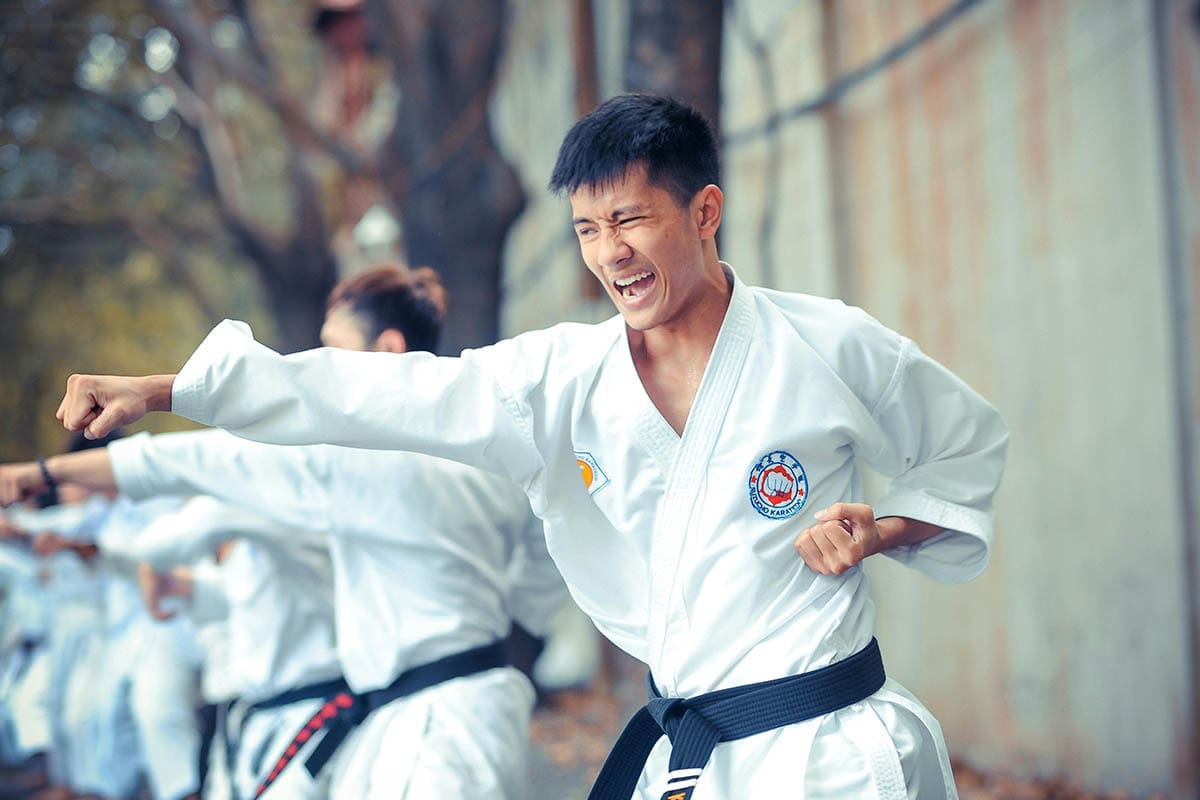
Sport plays an important role in Okinawan life, particularly outdoor and water-based activities. The variety and quality of sport on offer makes Okinawa worth visiting
Karate
Anyone familiar with the Karate Kid film franchise will know Okinawa as the home of Mister Miyagi. Okinawa has a deep history with the martial art, and many consider it the home of the Japanese style of karate. Okinawa even has a Karate Day (October 25th) with massive street demonstrations of the sport.
Diving and Snorkelling
Okinawa is widely considered Japan’s best diving destination.
The coral reefs surrounding the islands support incredible marine biodiversity, including tropical fish, manta rays, and sea turtles.
The Kerama Islands and Ishigaki are especially famous among divers.
Surfing
Several Okinawan beaches offer excellent surfing conditions, particularly during typhoon season when larger swells arrive.
Baseball
Baseball is huge in Japan, with superstar Shohei Otani setting records in the USA. The temperate climate in Okinawa means it has become the key location for Japanese professional teams’ spring training.
Watch Okinawa’s Unique Wildlife

Japan is a great wildlife destination, but Okinawa is the cherry on the cake. As with many of the world’s more isolated island chains, Okinawan wildlife has evolved to a high level of endemism. A very high percentage of certain flora and fauna types exists only on these islands, for example. 64% of terrestrial reptiles and 86% of amphibians.
Birdwatching in the Ryukyu Islands
Three of Japan’s rarest endemics can only be found here, including the Okinawa Rail, Okinawa Woodpecker and Okinawa Robin. These species, and the island’s location, draw birdwatchers from all over Japan. Some endemic mammals can also be seen on the islands, including the Amami black rabbit, the Ryukyu long-tailed giant rat, and the endangered Iriomote cat.
Whale Watching in Okinawa
December through April is prime whale-watching time in Okinawa, with humpback whales passing through the region. Whale watching tours report a 99% chance of a sighting on a trip, making Okinawa one of the world’s premier whale watching locations.
Watch Turtles lay eggs on Okinawan Beaches
The Okinawan islands are an important turtle nesting location, with green, loggerhead and hawksbill turtles returning here to lay eggs during May to August.
There are a number of beaches where turtles can be seen, but given their sensitivity to disturbance, it’s best to book onto an organised trip with experts. Alternatively, try the Okinawa Churaumi Aquarium which has an outdoor sea turtle pool specifically set up for turtles to lay their eggs.
Explore Okinawa’s Incredible Beaches

For many visitors, the beaches are the main reason to visit Okinawa.
The islands are home to some of the clearest water and whitest sand in Japan. This tropical paradise is the exact opposite of most tourists’ idea of Japan. The sea colour is extraordinary, while coral reefs create ideal conditions for snorkelling and diving.
Emerald Beach
Located within Ocean Expo Park in northern Okinawa Island, Emerald Beach is one of the most famous beaches in the prefecture. Divided into separate swimming and relaxation zones, it is an excellent introduction to Okinawa’s coastline.
Manza Beach
One of Okinawa’s best-known resort beaches, Manza Beach offers stunning views over crystal-clear water and dramatic coastal scenery. The nearby Cape Manzamo cliffs are also worth visiting for panoramic ocean views.
Nirai Beach
Less crowded than some of Okinawa’s resort beaches, Nirai Beach is known for gentle waves and excellent sunset views. It is popular with snorkellers because of its clear water and nearby coral formations.
Yonaha Maehama Beach
Often described as one of Japan’s most beautiful beaches, Yonaha Maehama on Miyakojima Island stretches for several kilometres with powder-soft white sand and vivid blue water.
Aharen Beach
Located in the Kerama Islands, Aharen Beach is famous for its snorkelling opportunities. Sea turtles are frequently spotted nearby, and its coral reefs are stunning.
When is the Best Time to Visit Okinawa?
The best time to visit depends on your priorities.
Spring
Warm temperatures and relatively low humidity make spring one of the best seasons for sightseeing and outdoor activities.
Summer
Perfect for beaches and diving, although humidity and typhoon risk increase significantly.
Autumn
Still warm enough for swimming, but often less crowded than in summer.
Winter
Mild temperatures make winter ideal for sightseeing and whale watching, although the sea may feel too cool for extended swimming.
Final Thoughts on What to See in Okinawa, Japan
Okinawa offers a side of Japan that many travellers never expect to find.
The islands combine tropical beaches, fascinating history, and exceptional food into a destination that feels completely distinct from mainland Japan.
Whether you want to snorkel above coral reefs, learn about the Battle of Okinawa, discover the birthplace of karate, or simply relax beside impossibly blue water, Okinawa delivers experiences unlike anywhere else in the country.
Is Okinawa worth visiting? For travellers seeking more than just Tokyo skyscrapers and Kyoto temples, the answer is definitely yes.
Latest Posts from Japan


Best Things to do in… Posts